How many sets per muscle group per week: 10 to 20
Between 10 and 20 hard sets per muscle per week to build muscle. Your number by level, what counts as a set, the minimum to maintain and what adding more brings.
To build muscle, the range drawn from research reviews runs from 10 to 20 sets per week for each muscle, taken close to the limit. What remains is to place your own number in it, by your level and by how you count.
In short
- As a benchmark, aim for 8 to 12 sets in your first year, then 12 to 18, and 15 to 20 if you are advanced.
- A set counts in full for the main muscle of the movement and as half for the muscles that assist; warm-up sets do not count.
- Two sessions per muscle mostly serve to spread that total; one a week can be enough to maintain, at the same weight, and going past twenty sets brings less and less.
This total is worth checking as soon as you leave a ready-made program or build your own.
Also read: Progressive overload: the one principle behind progress
How many sets per muscle per week depends on your level
Your level places you in a range drawn from two research reviews. In 2017, researcher Brad Schoenfeld’s team pooled 15 studies: muscle gain rises with the number of weekly sets, and the highest tier it separates starts at ten sets. In 2022, a review of seven studies, run in young men who already trained, settles on 12 to 20 sets per muscle group as a benchmark.
Neither gives a number by level. The benchmarks below are this article’s orders of magnitude.
The beginner benchmark drops below ten sets out of caution. After the first year, start from about twelve sets and add more only if you recover well: your weights hold or go up from one session to the next, and fatigue does not build up.
A set only counts if you take it close to the limit
In this article, only hard sets count, those that stop a few reps short of failure at most. The exact margin is decided before the set, with reps in reserve. Warm-up sets do not count. The total in kilos, the volume load, is a different measure.
When a movement works several muscles, the set counts in full for the main muscle and as half for those that assist. An analysis of 67 studies, published in 2026, compared three ways of counting these indirect sets: as one, as half or as zero. The half set is the one that fits the measured results best.
The breakdown below is this article’s, to be taken as a benchmark.
| Exercise | Full set for | Half set for |
|---|---|---|
| Bench press | Chest | Triceps, shoulders |
| Pull-up, row | Back | Biceps |
| Squat | Quads | Glutes |
| Deadlift | Hamstrings, glutes | Back |
| Curl, triceps extension | The target muscle | None |
Three sets of bench press, three of incline press and three of flyes give nine sets for the chest. The two presses add six half sets for the triceps, which makes three. Do this count over the whole week and write it down: that is the total you compare with the benchmark for your level.
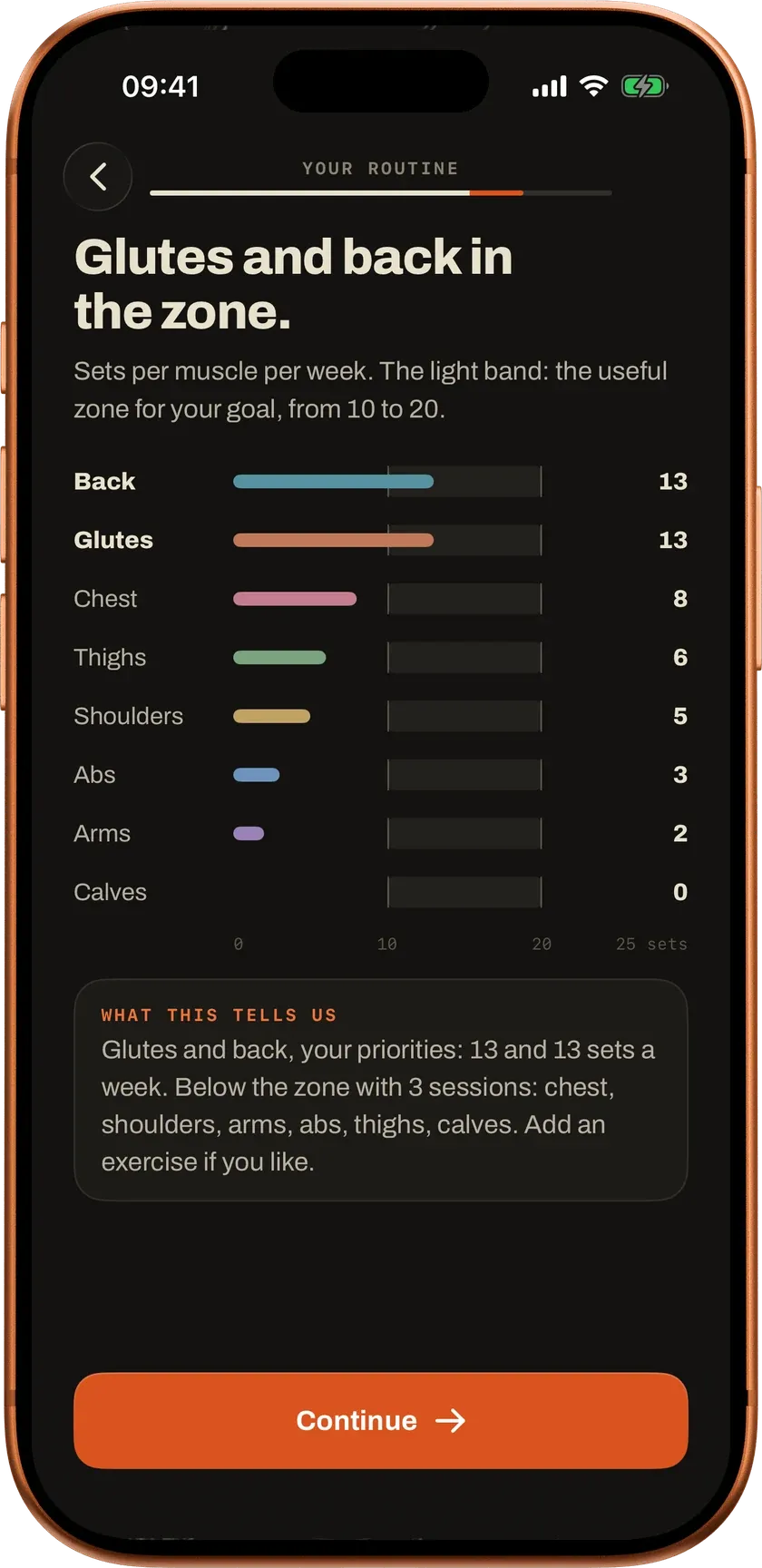
When Basalt Lab builds your routine during setup, the app shows its sets per muscle per week, over a light band: the useful zone for your goal.
The screen shown is a demo profile with three sessions. Back and glutes are at 13 sets, in the zone, and chest is at 8, below it: the screen points this out and suggests adding an exercise.
This zone of 10 to 20 sets is the one the app uses for building muscle. If you are a beginner, 8 chest sets stay within your starting benchmark. The app counts differently from this article: it assigns each set to a single muscle group, the one the exercise works most. Its totals are lower for the muscles that assist, such as the arms.
Frequency mostly serves to spread your sets across the week
Two meta-analyses by Brad Schoenfeld’s team compared training frequencies at equal volume. The 2016 one, on ten studies, concluded that two sessions a week build more muscle than one. The 2019 one, on 25 studies, no longer finds a significant difference at equal volume, and concludes that, for the same volume, frequency can be chosen by preference.
Two sessions per muscle remain a good practical setting: fourteen back sets fit better as two lots of seven than in a single session. The two examples below count full sets, without half sets.
Full body, three sessions. In the beginner full body program, chest and back reach 9 sets a week, and quads 7 or 8 depending on the week, at the bottom of the beginner benchmark or just below it.
Upper and lower, four sessions. The upper lower split reaches 10 chest sets and 12 back sets over the week.
To choose, read full body vs split.
A few sets can be enough to maintain your muscles, and going past twenty sets brings less and less
A 2021 review concludes that, in young adults, muscle strength and size can be maintained for up to 32 weeks with one session a week and one set per exercise, provided the weight stays the same. During a holiday or a busy stretch, you can therefore drop well below your benchmark for a while, as long as you keep your weights.
At the top of the range, according to the 2026 analysis, gains still rise with volume, but more and more slowly. In the 2022 review, going past 20 sets instead of doing 12 to 20 made no significant difference for the quads or the biceps; for the triceps, the high volume appeared to do better.
If your weights have stopped going up while your count is at the top of the range, adding sets is unlikely to be enough. Four questions help find the cause, and one simple rule tells you when to add weight. When fatigue sets in, a deload week helps bring it back down.
Frequently asked questions
How many sets per workout for one muscle?
Divide your weekly total by the number of sessions in which that muscle works. Twelve weekly sets over two sessions give six sets per workout.
How many sets per exercise?
The site’s beginner full body program uses two or three. The number to watch is still the muscle’s total over the week: three exercises at three sets make nine sets.
Is twenty sets per muscle per week too much?
Not if you are advanced and recover well: it is the top of the 12 to 20 sets retained by the 2022 review, run in young, trained men. In your first year, it is more than the benchmark of 8 to 12.
Sources
- Dose-response relationship between weekly resistance training volume and increases in muscle mass: A systematic review and meta-analysis, Schoenfeld B. J., Ogborn D. and Krieger J. W., Journal of Sports Sciences, 2017.
- A Systematic Review of The Effects of Different Resistance Training Volumes on Muscle Hypertrophy, Baz-Valle E. et al., Journal of Human Kinetics, 2022.
- The Resistance Training Dose Response: Meta-Regressions Exploring the Effects of Weekly Volume and Frequency on Muscle Hypertrophy and Strength Gains, Pelland J. C. et al., Sports Medicine, 2026.
- Effects of Resistance Training Frequency on Measures of Muscle Hypertrophy: A Systematic Review and Meta-Analysis, Schoenfeld B. J., Ogborn D. and Krieger J. W., Sports Medicine, 2016.
- How many times per week should a muscle be trained to maximize muscle hypertrophy? A systematic review and meta-analysis of studies examining the effects of resistance training frequency, Schoenfeld B. J., Grgic J. and Krieger J., Journal of Sports Sciences, 2019.
- Maintaining Physical Performance: The Minimal Dose of Exercise Needed to Preserve Endurance and Strength Over Time, Spiering B. A. et al., Journal of Strength and Conditioning Research, 2021.